Cold email template: 6 plain-text first emails
Pick a template by what you know about the prospect, spin every line, then run a placement test before the list goes out.
 Pv
Affiliate link. I may earn a commission if you subscribe, at no extra cost to you. Disclosure.
Send a first cold email of three short plain-text paragraphs with no link, and pick one of six templates by what you know about the prospect. This page is for anyone who writes a first cold email this week. You leave with a filled template, a spun version and a placement test you can run in PlusVibe.
This site may earn a commission if you buy PlusVibe through its links, at no extra cost to you.
| Line | What to write | Limit |
|---|---|---|
| Subject | The topic in a few plain words | Under five words, ideally under two |
| Greeting | First name only | One line |
| Paragraph 1 | The problem, in the prospect's terms | One short paragraph |
| Paragraph 2 | What you do about it | One sentence |
| Paragraph 3 | One open question | Ends the email |
| Signature | First name, last name, one specialty line, postal address | No logo, no image |
| Opt-out line | One plain sentence | Spun like the rest |
| Total | The whole body | Three short paragraphs |
Choose the template for your prospect
Start from what you know about this person today. That fact picks the template.
| You know | Use | Send it |
|---|---|---|
| A contact who suggested you write, or an event you both attended | A | Within a few days of the event or the introduction |
| Only the job title | B | Any time |
| A result at a company like theirs | C | Any time |
| A recent public event: a funding round, a hire, a launch | D | Within 30 days of the news |
| One real fact about their company | E | Any time |
| They are a CEO or a senior executive | F | Any time |
Woodpecker says a trigger event loses its relevance after two to four weeks, and ideally is under 30 days old. So send template D within 30 days.
Copy the six first emails
Every placeholder in square brackets is yours to fill. Each template ends with the same signature and opt-out line, which you will find after template F. Each filled example uses a made-up company, so do not copy its facts.
Template A is for a shared context. Name a mutual contact only with that person's agreement.
Subject: [Event]
Hi [First name],
[Contact] suggested I write to you, because [Company] is dealing with [problem].
We [what you do] for [type of company], so that [result].
How are you handling [problem] at the moment?
Filled example, invented. Subject: Freight summit. "Hi Dana, Sam Ortiz thought we should talk, because Northwind Freight is dealing with late proof-of-delivery paperwork. We help freight brokers close that paperwork the same day, so invoices go out sooner. Who closes out proof of delivery today?"
If the link is an event, swap the second line for "We were both at [event], where [problem] came up more than once."
Template B is for when you only know the job title.
Subject: [Process]?
Hi [First name],
Most [role]s we talk to [recurring problem], and [consequence].
We [solution in one sentence], which [result].
What does [problem] look like for you today?
Filled example, invented. Subject: Onboarding? "Hi Priya, most customer success managers we talk to rebuild the same onboarding checklist for every client, and new accounts start late. We turn the checklist into a template that fills itself in, which makes new accounts start on time. What does onboarding look like for you today?"
Template C is for a result at a comparable company. Name the client only if the client agrees. Otherwise describe it by size and sector.
Subject: [Peer sector]
Hi [First name],
A [peer: same size, same sector] had [problem] last year.
We [what we did], and [result the client allows us to tell].
What would the same be worth at [Company]?
Filled example, invented. Subject: Regional clinics. "Hi Marc, a 40-person dental group had a no-show problem last year. We moved their reminders from email to text and the group cut empty chairs. What would the same be worth at Harbor Dental?"
Template D is for a recent public event. Congratulate in one clause, then go straight to what the event changes for them.
Subject: Congrats on [event]
Hi [First name],
Saw the news about [event] at [Company]. After [event type], teams often face [consequence].
We help [type of company] with [problem], so that [result].
What is your plan for [consequence]?
Filled example, invented. Subject: Congrats on the new plant. "Hi Lena, saw the news about the second plant at Alder Foods. After a second site opens, teams often find their supplier data lives in two systems. We help food makers merge supplier records, so purchasing sees one price list. What is your plan for the merge?"
Template E is for one real fact about the company: a job post, a product page, a talk. If the fact could fit any company, use template B instead.
Subject: [Company]'s [thing]
Hi [First name],
I saw that [Company] [specific observation]. That usually creates [problem] for teams at your stage.
We [what you do], so that [result].
Who owns [problem] on your side?
Filled example, invented. Subject: Support hiring. "Hi Tom, I saw that Brightpath is hiring four support agents. That usually means tickets are growing faster than the team. We set up a first-reply bot for software companies, so agents handle fewer repeat questions. Who owns support volume on your side?"
Template F is for a CEO or senior executive. Keep it to two sentences and one question, and ask only for a pointer. Instantly's 2025 executive guide says the smallest ask works best, such as pointing you to the right person.
Subject: [Company] and [topic]
[First name],
We help [type of company] with [outcome in five words]. [Company] looks like a fit because [one reason].
Who is the right person to talk to about [topic]?
Filled example, invented. Subject: Orion Labs and billing. "Karim, we help software firms cut failed card payments. Orion Labs looks like a fit because it bills by usage. Who is the right person to talk to about billing?"
Close all six with your first name, last name, one specialty line and your postal address. Then add the opt-out line: "If this is not relevant, tell me and I won't write again." More templates for the second and third emails are in cold email follow-up templates.
Spin every line, signature and opt-out included
Every cold email should look unique, so it reads like a one-to-one message. I teach this in my January 2026 masterclass. Swapping the first name isn't enough, so vary the wording itself.
The syntax is simple. Put the choices inside curly braces and separate them with a pipe, as in {Quick question|A quick question}, according to PlusVibe's own blog. In a June 2025 video, I say it works on words, sentences and whole paragraphs. PlusVibe's blog advises spinning small zones, so keep each spun part short. Spin the signature and the opt-out line too. Template A spun looks like this:
{Hi|Hello} [First name],
{[Contact] suggested I write to you|[Contact] told me to get in touch}, because [Company] {is dealing with|is working through} [problem].
{We [what you do]|Our team [what you do]} for [type of company], so that [result].
{How are you handling|How does your team handle} [problem] {at the moment|right now}?
{If this is not relevant, tell me and I won't write again.|If this is not for you, say so and I will stop.}
Writing variants by hand takes hours, and you still end up with few of them. PlusVibe can write them for you. In the campaign sequence, paste a few sentences of copy and click "Use AI", then "Add Spintax". You choose how many extra variations each part gets and how many parts to spin. You can spin the subject line too.
Read every combination before you send. A variant can leave a word that doesn't agree with the next one. Check the opt-out line twice.
Strip the email to plain text
Four rules apply to the first email:
- No link. If you need one, the first email offers it and the follow-up carries it.
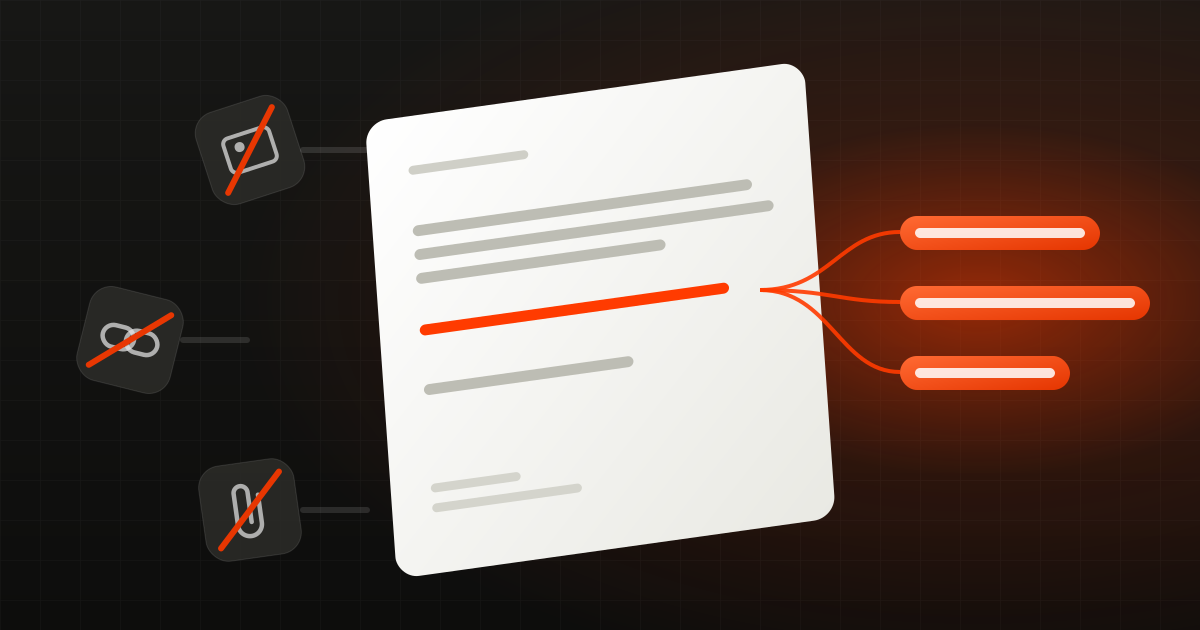
- No image or attachment, not even in the signature, and no HTML.
- No money words or superlatives: free, price, promotion, discount, exceptional.
- No open or click tracking. The tracking pixel is code, which goes against a plain-text email. Follow the reply rate and the positive reply rate instead.
Other sites say the opposite. Semrush recommends a headshot and a logo in the signature. GMass puts a booking link in its first email. UpLead suggests a P.P.S. with links. I send none of it. Each one is an image or a link, and either can push a first email away from the main inbox. The placement test below shows whether that happens to you.
Keep the subject under five words
In a December 2023 video, I set the limit at under five words, ideally under two. The plainest subject works, and so does a question or something informal. Test two subjects against each other once you have the volume. Woodpecker says to wait for a few hundred sends per variant, because smaller tests only measure noise.
Test inbox placement on each new copy
Before the full list goes out, send the email to test addresses and count where it lands. My target is more than 80 percent of test emails in the primary inbox. Run the test again on every new campaign, because the copy itself changes placement.
PlusVibe's plans page shows a $0, 14-day trial with no credit card. Its separate Email Placement Test plan starts at 300 credits a month, and the page has a monthly and yearly toggle for its price. Sending plans start at $37 a month for 25,000 emails. Run template B once spun and once unspun. Send the list only when placement clears 80 percent.
The test can't fix what the copy breaks. A link or an HTML signature in an otherwise clean email is what drags the result down. Don't trust the warm-up score inside your tool either. It is measured in a controlled pool of emails.
We also run a weekly check. We review each mailbox's seven-day reply rate in PlusVibe. We move the weakest mailboxes out of live campaigns into warm-up. They go back only after a clean placement test. The infrastructure choices that come before the first email are in six steps to stay out of spam.
How we checked this
Prices and spintax steps come from PlusVibe's own pages. Legal points come from the FTC guide, and the sending rules come from my videos, cited with timestamps in the sources. We didn't compare the six templates on reply rate, so none is ranked above another.
Where these numbers come from
- PlusVibe pricing page read 24 Nov 2026
- PlusVibe help center: AI-Powered Spintax Generation read 24 Nov 2026
- PlusVibe blog: What is spintax in cold email read 24 Nov 2026
- FTC: CAN-SPAM Act, a compliance guide for business read 24 Nov 2026
- Woodpecker: 9 cold email templates with full anatomy read 24 Nov 2026
- Woodpecker: how long should a cold email be read 24 Nov 2026
- Instantly: how to cold email executives read 24 Nov 2026
- Semrush: 11 cold email templates read 24 Nov 2026
- GMass: B2B cold email templates read 24 Nov 2026
- UpLead: cold email templates read 24 Nov 2026
- Louis Deslus on YouTube, January 2026 (plain text and signature) read 16 Jan 2026
- Louis Deslus on YouTube, January 2026 (money words) read 16 Jan 2026
- Louis Deslus on YouTube, January 2026 (tracking pixel) read 16 Jan 2026
- Louis Deslus on YouTube, January 2026 (reply rate) read 16 Jan 2026
- Louis Deslus on YouTube, January 2026 (unique emails) read 16 Jan 2026
- Louis Deslus on YouTube, January 2026 (spun signature) read 16 Jan 2026
- Louis Deslus on YouTube, January 2026 (rereading variants) read 16 Jan 2026
- Louis Deslus on YouTube, January 2026 (opt-out line) read 16 Jan 2026
- Louis Deslus on YouTube, January 2026 (placement target) read 16 Jan 2026
- Louis Deslus on YouTube, January 2026 (placement on each campaign) read 16 Jan 2026
- Louis Deslus on YouTube, January 2026 (no link in the first email) read 16 Jan 2026
- Louis Deslus on YouTube, January 2026 (warm-up score) read 16 Jan 2026
- Louis Deslus on YouTube, December 2023 (three paragraphs) read 8 Dec 2023
- Louis Deslus on YouTube, December 2023 (subject line) read 8 Dec 2023
- Louis Deslus on YouTube, December 2023 (A/B test) read 8 Dec 2023
- Louis Deslus on YouTube, June 2025 (syntax) read 30 Jun 2025
- Louis Deslus on YouTube, June 2025 (writing by hand) read 30 Jun 2025
- EraB2B team notes, November 2026 dated 13 Nov 2026
What people still ask
How long should a cold email be?
Use three short paragraphs at most, in the order problem, solution, call to action. Woodpecker's guides disagree on the word count: its 2025 length guide says 75 to 125 words for a first email, and its 2026 template guide says 50 to 150. Executive emails are often under 75 words. The templates here are shorter, because they stop at three short paragraphs.
What should the subject line be?
Use under five words, ideally under two. Name the topic in plain words, the way a colleague would. Semrush advises about 45 characters at most so the subject is not cut on a phone.
How many follow-ups should I send?
Woodpecker suggests three to five emails after the first one, over three to four weeks. The follow-up templates are in the cold email follow-up article linked below the templates.
Do templates still work if everyone copies them?
Only if you change the wording each time. Spintax does this by choosing between variants for each send, so no two prospects get the same email. Woodpecker also says to write the opener fresh for each prospect.
Is cold email legal in the US?
The FTC's CAN-SPAM guide says the law makes no exception for business-to-business email. Each message needs your valid postal address and a clear way to opt out. You must honor an opt-out within 10 business days. This is not legal advice.